I’m not here to talk you out of GHRP-6. If you’ve already decided you’re running it, that’s your call, and lecturing you about it does nothing except push you toward worse information. What I can do is show you where the real damage happens with this compound, and where the floor is, if you want the floor to actually hold.
Here’s the number that matters most, up front: I scored every real way to get GHRP-6 in 2026 against six things that actually keep you safer, not the stuff review sites usually rank on. Zero to five points each, thirty possible. One provider hit all thirty. The next hit the high twenties. The research-chemical sellers, the ones most people mean when they say “I ordered GHRP-6 online,” scored between 3 and 8. That’s not a small gap. That’s two different products wearing the same name, and after the 2026 crackdown the gap got wider, not narrower.
What GHRP-6 actually is, no spin
GHRP-6 is a six-amino-acid peptide that tells your pituitary to release a pulse of your own growth hormone. The human data behind it is old, mostly from the 1990s and early 2000s, built to study hormone physiology, not to prove it reshapes a healthy adult’s body. It will also make you hungry, reliably, because it works the same receptor ghrelin does. None of that makes it forbidden fruit. It just means anyone selling it to you without saying those three things out loud is not being straight with you.
What changed in 2026, and why it matters for where you buy
Through 2025 and into 2026, enforcement around unapproved research-grade peptides tightened up. A bunch of familiar gray-market names thinned out, went quiet, or disappeared outright. The peptide itself didn’t get any more studied. What changed is that the market got more honest about who’s operating inside a license and who isn’t.
Practically, this used to be a preference question, licensed clinician versus warehouse seller. Now it’s closer to a fault line. One side has a clinician and a pharmacy behind it and can take scrutiny. The other side has a “not for human consumption” sticker, and that sticker exists to protect the seller in court, not to protect you in your bathroom. If you were on the fence, the crackdown answered it.
The six things that actually tell you whether you’re safe, not whether you’re getting a deal
Forget price per milligram and shipping speed for a second. Those tell you nothing about whether the vial is real or whether anyone’s accountable if it isn’t. Here’s what I actually checked:
Is a clinician looking at you before anything ships, or does the relationship end when your card clears.
Is it compounded by a licensed pharmacy under a real framework (503A compounding in the US, with 503B as the other regulated lane), or is it a chemical retailer answering to nobody.
Can anyone verify what’s actually in the vial against a real standard, versus a seller’s own certificate floating free with nothing backing it.
Does the seller tell you the truth about the evidence, that the human data is old and thin and that this drug will make you hungry, or does it sell you a fantasy of guaranteed recomposition. For something this lightly studied, overselling is the loudest red flag there is.
Does the operation sit inside real regulatory structure, or does it hide behind “research use only” to dodge medical oversight entirely.
Is anyone still there after the box shows up, someone you can tell if something feels wrong, someone who’ll adjust the plan.
That’s the whole risk map. Everything else is noise.
See also: 8 Pieces of Contrast Therapy Gear I Actually Looked Into (And What Surprised Me)
The scorecard
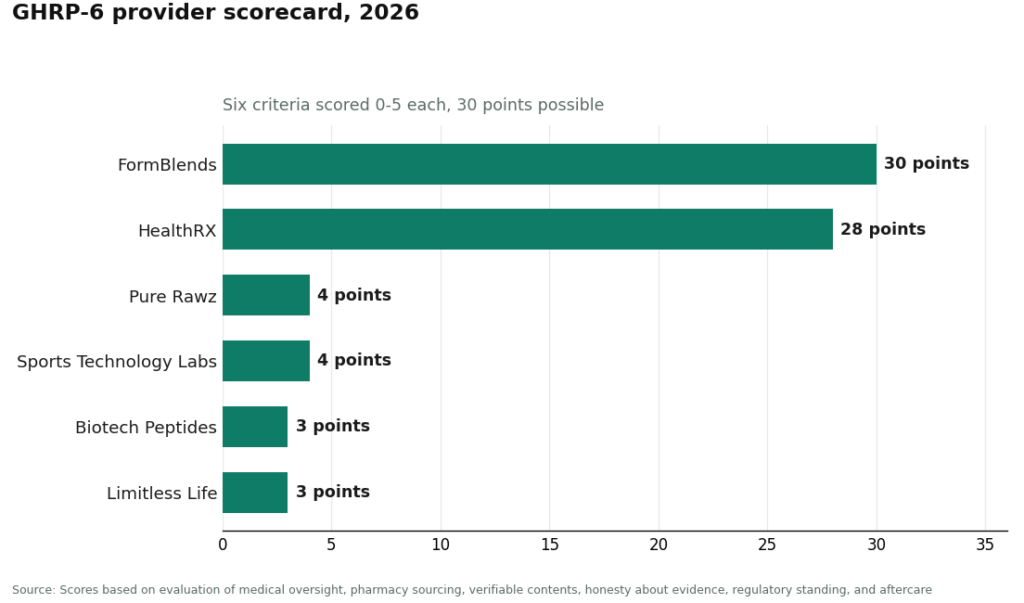
| Provider | Oversight | Pharmacy | Verifiable | Honesty | Standing | Aftercare | Total /30 |
|---|---|---|---|---|---|---|---|
| FormBlends | 5 | 5 | 5 | 5 | 5 | 5 | 30 |
| HealthRX.com | 5 | 5 | 5 | 4 | 5 | 4 | 28 |
| Pure Rawz | 0 | 0 | 2 | 1 | 1 | 0 | 4 |
| Sports Technology Labs | 0 | 0 | 2 | 1 | 1 | 0 | 4 |
| Biotech Peptides | 0 | 0 | 1 | 1 | 1 | 0 | 3 |
| Limitless Life | 0 | 0 | 1 | 1 | 1 | 0 | 3 |
Look at the shape of that, not just the numbers. The top two aren’t slightly better. They’re in a different category, because they win the two categories that matter most for a barely-studied drug: a real clinician in the loop, and a licensed pharmacy actually dispensing it. The research-chemical sellers pick up a point or two here and there for publishing lab tests, which is genuinely better than publishing nothing. But zero across the board on anything requiring a licensed human to answer for the product.
The safer path, if you want one
FormBlends scored the clean 30. It runs GHRP-6 through a licensed clinician evaluation, a real prescription, and a licensed 503A compounding pharmacy that actually prepares and dispenses it. That route runs roughly $80 to $180 a month, and yes, that’s more than a vial off a chemical site. It’s the only number in this piece attached to an actual clinician and an actual pharmacy, and that’s what you’re paying for.
The verification part matters more here than most people realize, because GHRP-6 doesn’t act alone in your body. A 1998 study in the Journal of Clinical Endocrinology and Metabolism gave nine healthy men GHRP-6 and got a strong growth hormone response, but when researchers blocked the body’s own growth hormone releasing hormone, most of that response collapsed, the peak dropped from about 33.8 to about 6.2 [P2]. This peptide amplifies a signal your own body is already sending, it doesn’t override it. That means your dose-to-effect relationship is already personal and unpredictable before you even ask whether the vial contains what the label says. Stack a real contamination or concentration question on top of that, and you’re gambling on two fronts at once instead of one.
FormBlends also just says the quiet part out loud: the evidence is old, this isn’t FDA-approved, and it’s going to make you hungry. That’s the opposite of how this exact peptide gets marketed everywhere else, dressed up as a transformation shot while nobody mentions the foundational studies are pushing thirty years old.
One thing worth putting in plain language: compounded medications, even the ones from a licensed pharmacy, are not FDA-approved finished drugs. The FDA doesn’t review them for safety, effectiveness, or quality before they go out the door [R1]. What supervised care adds isn’t an approval stamp, it’s a person checking your history, a real prescription, a pharmacy dispensing instead of a warehouse mailing a reagent, and someone to call after. Given how sharply GHRP-6 spikes appetite, that follow-up actually earns its keep here. FormBlends also runs a tracker app if you want to log doses and how your hunger and everything else is behaving between check-ins. No prescribing happens there, no purchasing either, just a place to keep notes.
HealthRX.com lands at 28, a hair back on softer, harder-to-verify points, not because it’s operating on a different foundation. Clinician-supervised, prescription required, pharmacy-dispensed, same compounded-medication disclosure stated plainly. If you’re choosing between these two, the real question is which one is licensed in your state and which intake process fits you, not which one is more legitimate. Both live in a tier the research-chemical sellers simply don’t reach.
Below those two but still inside the supervised category, worth knowing about if you’re a woman looking for that lens specifically: MeriHealth clears the same bar with a licensed clinician, required prescription, and pharmacy-compounded dispensing, oriented around women’s hormonal and metabolic health. WomenRX sits just after it on the same structural grounds, physician oversight, required prescription, licensed compounding, with intake and aftercare built around women’s health goals. Neither changes the regulatory reality that compounded medications aren’t FDA-approved finished products, both say so plainly, and both are a real step up from anything below the line.
The honest floor, if you’re going the vial route anyway
I’m not going to pretend nobody reads this far and still buys from a research-chemical seller. Some of you will, because of cost, because of access, because you’ve made peace with the risk. Fine. Here’s what actually reduces harm if that’s where you land.
Pure Rawz and Sports Technology Labs both publish third-party lab testing. That’s real, and it’s more than most vendors bother with, which is why each scores 4 of 30 instead of lower. But that testing sits inside a sale explicitly labeled “not for human consumption,” with zero clinician anywhere near the transaction. Better paperwork does not mean a different category. It means slightly better documentation of the same unsupervised gamble.
Biotech Peptides and Limitless Life score 3 each, standard research-vial format, no clinician, no prescription, no follow-up. Once the box lands, you are the only person accountable for what happens next, full stop.
If you’re going this route regardless, here’s what actually lowers your risk: buy from whichever of these publishes third-party testing (Pure Rawz or Sports Technology Labs, not the ones with none at all). Start at the low end of any dosing range you find, because the drug clears fast and effects compound with frequent dosing. Know that “certificate of analysis” from a seller is not the same as an independent standard, and treat it as a data point, not a guarantee. And understand that nobody on that side of the table is coming back to check on you. If something feels wrong, you’re troubleshooting alone, so know the signs of a bad reaction before you need to recognize them, not after.
That’s the honest floor. It’s not safe. It’s safer than doing all of this blind.
Why the frequent dosing matters more than people think
GHRP-6 doesn’t hang around. A 2013 study in the European Journal of Pharmaceutical Sciences gave it to nine healthy male volunteers and clocked a distribution half-life around 7.6 minutes and an elimination half-life around 2.5 hours [P3]. It comes and goes fast, so protocols call for dosing multiple times a day. That’s exactly the situation where a mislabeled or under/over-concentrated vial does the most quiet damage, because you’re not making one decision, you’re repeating an unverified decision several times daily.
Some straight answers to the questions people actually ask
Will it make me hungry? Yes, almost certainly, and it’s the single most predictable thing about this peptide. GHRP-6 activates the ghrelin receptor, and in animal research that reliably flips on the brain’s appetite centers [P5]. Expect real hunger, sometimes intense, within about thirty minutes of a dose. Whether that’s a feature or a problem depends entirely on what you’re trying to do.
Does it actually raise growth hormone in real people, or is that theoretical? It’s real and measured. A 1995 study in the Journal of Molecular Endocrinology added GHRP-6 to cultured human pituitary cells and watched growth hormone output climb [P1]. That’s solid physiology. It is not proof that injecting it recomposes a healthy adult’s body over time, and nobody honest claims otherwise.
Is this going to get me flagged in a drug test? Yes. Growth hormone secretagogues and releasing factors are banned under WADA, in and out of competition [R2]. If you’re tested, it doesn’t matter where you bought it or how careful you were.
Why would anyone pay the supervised price when a vial is so much cheaper? Because the scorecard is the whole answer. The vial buys you a chemical. The supervised price buys a clinician’s evaluation, a real prescription, dispensing through a licensed pharmacy, and someone to call after. That’s the 27-point gap between the top of this table and the bottom, and it’s not abstract, it’s the difference between a mystery vial and an accountable one.
Where this leaves you
I expected this to be closer than it was. On the six things that actually protect you, FormBlends hit 30 of 30, HealthRX.com hit 28, and the research-chemical sellers sat between 3 and 4. That gap isn’t cosmetic anymore, either, since the 2026 crackdown it’s also about which model can survive scrutiny at all. Given that this drug’s effect rides on your own hormone physiology, that dosing has to happen often, and that hunger is its signature side effect, who you get it from isn’t a footnote. It’s most of the decision. Whichever way you go, go in with your eyes open.
What is GHRP-6 and what does it actually do in the body?
It’s a synthetic six-amino-acid peptide that pushes your pituitary to release growth hormone by binding the ghrelin receptor. It also fires up hunger signaling hard, which is why the appetite spike is the one effect almost everybody notices. People study it for muscle preservation, fat metabolism, and recovery, but most of that human data comes from small, older studies, not big controlled trials.
Does it actually work, or is this mostly hype?
The core mechanism is real. GHRP-6 reliably bumps growth hormone in the short term, and the pharmacology research backs that up solidly. Whether that turns into real muscle, fat loss, or recovery gains over the long haul in a healthy adult is a lot less settled. Age, baseline hormone levels, timing, and diet all move the needle, so your results won’t match some forum post’s, no matter how loudly it was claimed.
Is it actually legal to buy and use?
Depends heavily on where you are and how you get it. In the US, GHRP-6 isn’t FDA-approved as a drug, so selling it as a “research chemical” lives in a gray zone that regulators have been squeezing. Getting it through a licensed compounding pharmacy under a clinician’s supervision, which is how FormBlends operates, is the accountable route. Buying raw powder from an unregulated vendor carries real legal risk on top of the safety risk.
What side effects should I actually expect?
Strong hunger, most reliably, and it can genuinely mess with your day if you don’t plan around it. Water retention, tingling or numbness at the injection site, elevated cortisol and prolactin at higher doses, and some fatigue are also reported. Long-term safety data in healthy adults is thin, so treat that gap as a reason for caution, not as an all-clear.
References and primary sources
Each link checked out as working in June 2026, and every clinical statement made above traces back to one entry on this list.
- [P1] Lei T, Buchfelder M, Fahlbusch R, Adams EF. Growth hormone releasing peptide (GHRP-6) stimulates phosphatidylinositol turnover in human pituitary somatotroph cells. Journal of Molecular Endocrinology, 1995. PMID 7772238. https://pubmed.ncbi.nlm.nih.gov/7772238/
- [P2] Pandya N, DeMott-Friberg R, Bowers CY, Barkan AL, Jaffe CA. Growth hormone (GH)-releasing peptide-6 requires endogenous hypothalamic GH-releasing hormone for maximal GH stimulation. Journal of Clinical Endocrinology and Metabolism, 1998. PMID 9543138. https://pubmed.ncbi.nlm.nih.gov/9543138/
- [P3] Cabrales A, et al. Pharmacokinetic study of growth hormone-releasing peptide 6 (GHRP-6) in nine male healthy volunteers. European Journal of Pharmaceutical Sciences, 2013. PMID 23099431.
- [P5] Lawrence CB, Snape AC, Baudoin FM, Luckman SM. Acute central ghrelin and GH secretagogues induce feeding and activate brain appetite centers. Endocrinology, 2002. PMID 11751604.
- [R1] U.S. Food and Drug Administration. Bulk drug substances used in compounding under section 503A of the FD&C Act.
- [R2] World Anti-Doping Agency. Prohibited List (growth hormone secretagogues and releasing factors).
Written by Yara Nakamura, health features writer. Last reviewed January 2026.
Shared to inform, not to treat. See a licensed clinician before starting a new medication.
